




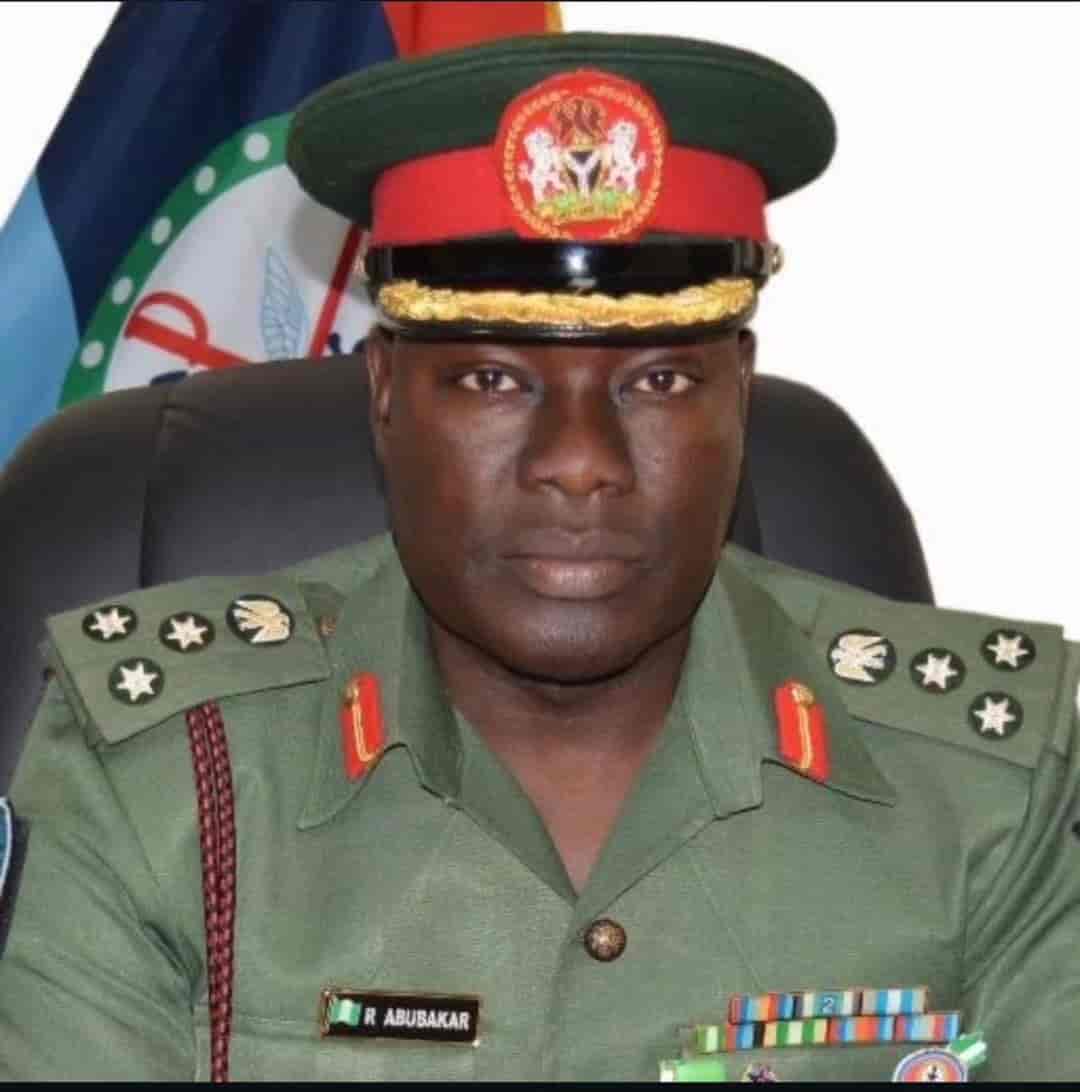
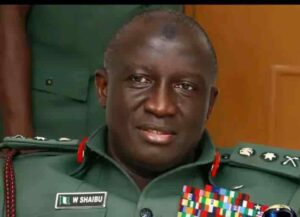
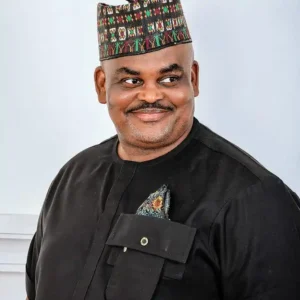
Major General Rabe Abubakar Biography, If you followed Nigerian news during the worst years of the Boko Haram insurgency, there’s a good chance you saw this man’s face before you ever learned his name. For years, Rabe Abubakar spoke from podiums and press briefings about jihadists, bandits and other terrorists wreaking havoc across the country, amplifying military operational gains, explaining setbacks, disputing allegations and reassuring nervous civilians that the war was being won.
He wasn’t a politician or a celebrity in the conventional sense, but for two intense years he was arguably one of the most recognizable institutional voices in the country. Think of him as the man standing between the battlefield and the living room translating chaos into something the public could understand, even when the news itself was grim.
He stood before cameras when soldiers captured terrorist strongholds, and he defended the military when international organisations accused it of abuses. What makes his story so gut-wrenching is how it ended not on a battlefield he had spent decades describing to others, but in the hands of the very kind of armed group he once briefed the nation about. That irony hasn’t been lost on a single Nigerian newsroom that has covered his passing.
Early Life and Origin
Birth and Hometown in Katsina State
Every biography has to start somewhere, and for Rabe Abubakar, that somewhere was the dusty, close-knit terrain of northern Nigeria. He was born on April 7, 1965, in the Batsari Local Government Area of Katsina State, and his northern upbringing laid the foundation for what would become a long career in public service.
Katsina isn’t just a footnote in his story it’s practically a character in it, since it’s also the state where his life would later come full circle in the most tragic way imaginable. Growing up in Batsari in the mid-1960s meant growing up in a Nigeria still finding its footing after independence, a place where community, faith, and discipline shaped a child long before any uniform did.
He attended primary and secondary schools in Katsina State, building the educational base that would eventually carry him into the officer corps of the Nigerian Army. It’s worth pausing on this point: many of the men who go on to become generals in Nigeria didn’t start in elite academies or wealthy households they started in small-town classrooms exactly like the ones Abubakar passed through, which is part of why his rise resonated with so many ordinary Nigerians.
Education Background
Abubakar’s academic path took a slightly unusual turn for a future military man he leaned into the humanities rather than the sciences. Publicly available biographies indicate that he earned a Bachelor of Arts degree in History before joining the Nigerian Army, although the specific university he attended cannot be independently verified from available records.
That’s not an unusual gap in the public record for Nigerian military officers, whose academic histories are rarely documented with the same thoroughness as their service records. A History degree, interestingly enough, turned out to be excellent preparation for a man who would spend years explaining the present by framing it within the context of ongoing conflict understanding the “why” behind events, not just the “what.”
It’s almost poetic that someone trained to study and narrate the past ended up becoming the army’s chief narrator of present-day conflict. He later complemented this academic background with extensive global military training, including the Company Amphibious Course and other strategic communication programmes that sharpened his professional toolkit.
Military Career and Rise Through the Ranks
Commissioning and Early Postings
Every general was once a rookie, and Abubakar’s military journey officially began in the late 1980s. He was commissioned as a Second Lieutenant into the Nigerian Army in 1989, steadily building a reputation for tactical precision and effective strategic communication as he moved through the ranks. Picture nearly three decades of postings, transfers, training courses, and quiet administrative grind the unglamorous machinery that eventually produces a general.
Most of that early climb happened far from cameras and headlines, which is part of why so little is publicly documented about his day-to-day life in those years. The late general built much of his career largely away from public attention, serving in various command and administrative capacities before stepping into the national spotlight.
That kind of quiet, steady rise is the norm rather than the exception for senior Nigerian military officers the spotlight usually only finds them once they’re appointed to a communications or command role that puts them in front of journalists.
Niger Delta Service
One of the clearest signals that Abubakar had a gift for managing information under pressure came in the late 2000s, during a turbulent chapter in Nigeria’s Niger Delta region. In 2008, as a Lieutenant Colonel, he was appointed Coordinator of the Joint Media Campaign Centre under the Joint Task Force’s Operation Restore Hope in the Niger Delta, where he skilfully managed media relations amid volatile militancy and attacks on critical oil infrastructure.
If you know anything about that period, you know it wasn’t an easy assignment militant attacks on pipelines, kidnappings of oil workers, and a constant tug-of-war between government narratives and grassroots anger made the Niger Delta one of the most sensitive communications postings in the entire armed forces.
Surviving and even thriving in that environment likely taught him lessons he would later apply on a much bigger national stage. His adept handling of crises in that period led to a series of strategic appointments, including Commandant of the Nigerian Army School of Public Relations and Information in Lagos, and Executive Director of Corporate Affairs at Nigerian Army Welfare Limited.
Becoming Director of Defence Information
This is the role most Nigerians associate with his name. In August 2015, Abubakar succeeded Major General Chris Olukolade as Director of Defence Information, stepping into the national spotlight at the height of the Boko Haram insurgency.
Imagine inheriting one of the most scrutinized communications jobs in the country at the exact moment public confidence in the military’s counter-insurgency campaign was being tested almost daily. That’s the seat he stepped into.
Major General Rabe Abubakar Batsari gained national recognition during his tenure as Director of Defence Information, serving as the chief spokesperson of the Nigerian Armed Forces under former President Muhammadu Buhari’s administration. Every military operation, every controversy, every accusation of human rights abuse it all eventually landed on his desk for response.
Voice of the Armed Forces During the Boko Haram Years
His tenure as DDI ran from 2015 to 2017, a period during which Nigeria battled severe counterinsurgency challenges in the North-East, and Abubakar became the public face of the military, regularly briefing the nation and shaping defence policy narratives.
Briefing journalists week after week about an active insurgency isn’t a job for someone who rattles easily you’re constantly balancing operational security, public morale, and the brutal honesty that good journalism demands.
In that role, he emphasized media synergy and civil-military relations in his briefings, becoming one of the key voices communicating military operations and counter-terrorism updates to the public. Following that posting, he was reassigned as Director of Information Management within the Department of Civil-Military Affairs at Army Headquarters, a role that kept him close to strategic communications even as his frontline spokesperson days wound down.
Final Rank and Retirement
Abubakar eventually retired from active service carrying the rank of Major General, a two-star rank that places an officer among the senior leadership tier of the Nigerian Army, just below Lieutenant General. Retirement, though, didn’t mean he disappeared from public life.
Even after retiring from active service, Abubakar remained a vital and respected voice in national conversations surrounding security, intelligence, and governance. That’s a detail worth sitting with plenty of retired officers fade quietly into private life, but Abubakar kept showing up in commentary and analysis circles, still trusted as someone who understood Nigeria’s security architecture from the inside out.
It’s exactly that continued visibility and credibility that made the manner of his death feel so much more devastating to the public than it might have for a lesser-known retiree.
Age at the Time of His Death
Doing the simple math here tells its own story. Born on April 7, 1965, and confirmed dead in mid-June 2026, Major General Rabe Abubakar was 61 years old at the time of his passing. Sixty-one isn’t old by modern standards it’s an age where many retired professionals are still active, mentoring younger colleagues, attending community events, and enjoying the freedom that comes after decades of disciplined service.
That’s precisely what makes his death sting that much more for those who knew him: he wasn’t a frail elder succumbing to the natural end of a long life. He was a man who, by all accounts, should have had years of comfortable retirement ahead of him before circumstances entirely outside his control cut that short.
Wife and Family
Hajiya Amina Abubakar
Behind every public figure is usually a family quietly bearing the weight of that visibility, and in Abubakar’s case, his wife shared not just his life but, tragically, his final ordeal. Rabe Abubakar, a former Director of Defence Information, was abducted alongside his wife, Hajiya Amina Abubakar, in a kidnapping that shocked the country.
Picture the sheer terror of that scenario a retired couple, presumably travelling for an ordinary reason, suddenly thrust into a hostage situation together. The wife of the late retired Major General Rabe Abubakar was reportedly released by her kidnappers, while the body of the former Nigerian army officer was also handed over to his family for burial.
There’s a small, bittersweet mercy in that detail that she survived the ordeal that ultimately claimed her husband’s life, even as the broader story remains heartbreaking for everyone involved.
Children and Personal Life
This is one area where the public record genuinely runs thin, and rather than guess, it’s more responsible to say so plainly. None of the credible news outlets covering Abubakar’s life and death from regional papers to national dailies have published verified names, ages, or details about his children.
That’s not unusual for senior Nigerian military officers, many of whom deliberately keep their immediate families out of the press even during high-profile career moments, let alone tragic ones. According to family sources, preparations were made for his burial in Katsina, where funeral rites were conducted in accordance with Islamic traditions, with the broader Abubakar family and community sharing in the grief.
What is clear is that he leaves behind a family that, by every account, is currently mourning privately and deserves the space to do so without speculative details being attached to their names.
Salary and Net Worth
Nigerian Army Pay Scale for a Major General
People are naturally curious about what a position like Director of Defence Information actually pays, and while exact personal payslips are never published, general pay-scale data for the Nigerian Army gives a useful frame of reference.
According to recent breakdowns of the Nigerian Army’s salary structure, a Major General earns roughly ₦1,150,500 monthly, while a Lieutenant General collects around ₦1,900,500, and a full General sits at the top of the commissioned ranks earning approximately ₦2,500,500. Here’s how that compares across a few benchmark ranks:
| Rank | Estimated Monthly Salary (₦) |
|---|---|
| Second Lieutenant | ₦240,000 |
| Captain | ₦320,500 |
| Major | ₦380,500 |
| Lieutenant Colonel | ₦420,500 |
| Colonel | ₦580,500 |
| Brigadier General | ₦750,500 |
| Major General | ₦1,150,500 |
| Lieutenant General | ₦1,900,500 |
| General | ₦2,500,500 |
It’s worth flagging that these figures come from independent pay-scale analyses rather than an official government payslip, so they should be treated as estimates rather than gospel.
Since Abubakar was retired by the time of his death, his actual monthly income would have shifted from active-duty pay to a military pension, which typically runs at a percentage of final salary depending on years of service and rank at retirement a detail Nigeria’s defence pension authorities don’t publicly itemize for individual officers.
What Is Known About His Net Worth?
Here’s where it’s tempting to throw out a flashy dollar figure, and where honesty matters more than clickability. No credible, independently verified net worth figure for Major General Rabe Abubakar exists in any of the reputable reporting on his life or death.
Nigerian senior military officers are not legally required to publicly disclose personal assets the way elected officials sometimes are, and outside of his known military salary and pension entitlements, there’s simply no documented breakdown of property, investments, or business interests attributed to him.
Any specific net worth figure circulating online for him should be treated with real skepticism, since it almost certainly isn’t sourced from anything verifiable it’s the kind of number that tends to get invented rather than reported, especially in the rushed days following a public figure’s death.
The Kidnapping and Tragic Death
This is the part of the story that turned a respected retired general into national headlines all over again, for all the wrong reasons. In May 2026, Abubakar was thrust back into the headlines under tragic circumstances when he and his wife, Hajiya Amina Abubakar, were ambushed and abducted by armed bandits along the Marabar Musawa-Kafinsoli Road in Matazu Local Government Area of Katsina State.
An eyewitness account indicated the abduction occurred within that same Matazu area, a region that has recorded repeated attacks by armed groups in recent years, and the family later confirmed that Abubakar’s driver escaped the scene after sustaining a gunshot injury.
The vehicle involved, described as a red Peugeot 504, was eventually recovered and taken to local police headquarters a small, eerie detail that underscores just how ordinary the journey must have seemed right up until it wasn’t.
What followed was weeks of uncertainty and, presumably, intense behind-the-scenes negotiation. On June 6, a video showing Abubakar and his wife appealing to the Katsina government for the release of detained bandits and livestock surfaced online, a desperate plea that circulated widely before his death was confirmed.
Shortly after, the Katsina state government confirmed that Abubakar had died in bandits’ captivity, with a statement from the commissioner for internal security and home affairs attributing his death to complications of diabetes and hypertension. The Defence Headquarters subsequently issued a statement conveying its deepest sympathies to the Abubakar family, his colleagues and all Nigerians, lauding him for serving the nation with distinction throughout his military career and after retirement.
His body was eventually released to his family, and he was buried at Gidan Dawa Cemetery in Katsina, with a crowd of family, comrades, officials and well-wishers standing in final salute as he was lowered into the ground following funeral prayers attended by hundreds.
Legacy
It’s hard to sum up a man who spent decades as the calm, steady voice explaining chaos to a worried nation, only to become a victim of the exact kind of violence he once stood at podiums describing. Whether remembered as an effective communicator, an unwavering institutional loyalist, or a spokesperson whose optimism sometimes outpaced realities on the ground, he occupied a unique place in Nigeria’s security history.
For an entire generation of Nigerians who came of age during the height of the Boko Haram crisis, his face and voice were practically synonymous with the military’s public response to terror.
His death has reignited difficult conversations about banditry in Katsina State and the broader North-West, regions where, despite years of military briefings just like the ones he once delivered, insecurity continues to claim lives including, in a cruel twist of fate, the life of the man who once tried to reassure Nigerians that the tide was turning.
Conclusion on Major General Rabe Abubakar Biography
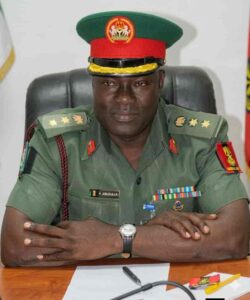
Major General Rabe Abubakar’s story is really two stories stitched together one of a disciplined, decades-long military career that took a small-town boy from Batsari all the way to becoming the recognizable face of Nigeria’s Armed Forces, and another, far darker story of how that same security apparatus he once represented couldn’t ultimately protect him from the violence plaguing his home state.
He leaves behind a wife who survived their shared ordeal, a grieving family, and a legacy built on years of steady, credible communication during one of Nigeria’s most difficult security chapters.
While speculative details about his net worth or private family life remain unverified and probably always will, what’s beyond dispute is the respect he earned across military and civilian circles alike, and the genuine national mourning that followed his death.
FAQs on Major General Rabe Abubakar Biography
1. How old was Major General Rabe Abubakar when he died? He was born on April 7, 1965, and died in mid-June 2026, making him 61 years old at the time of his death.
2. What was Rabe Abubakar’s rank in the Nigerian Army? He retired as a Major General, a senior two-star rank in the Nigerian Army, after a military career spanning nearly three decades.
3. How did Major General Rabe Abubakar die? He died while in the captivity of armed bandits who had abducted him and his wife in Katsina State; state officials attributed his death to complications from diabetes and hypertension.
4. Who was Rabe Abubakar’s wife? His wife was Hajiya Amina Abubakar, who was abducted alongside him in May 2026 and was later released by their captors before his death was confirmed.
5. What is Major General Rabe Abubakar’s net worth? There is no independently verified net worth figure for him in any credible report. His documented income is limited to his military salary and pension as a retired Major General, and any specific net worth claims circulating online are not backed by verifiable sources.






+ There are no comments
Add yours